It is Automotive QMS standard. This standard cancels and replaces ISO/TS 16949:2009 (3rd edition). It explains Quality system requirements for Automotive industries.
The goal of IATF16949 is to develop a quality management system that provides continuous improvement.
Moreover, it emphasizes defect prevention and reduces waste in the supply chain.
Scope of IATF16949: – Moreover, this standard defines QMS requirements for design and development, production, assembly, installation, and services of automotive related products.
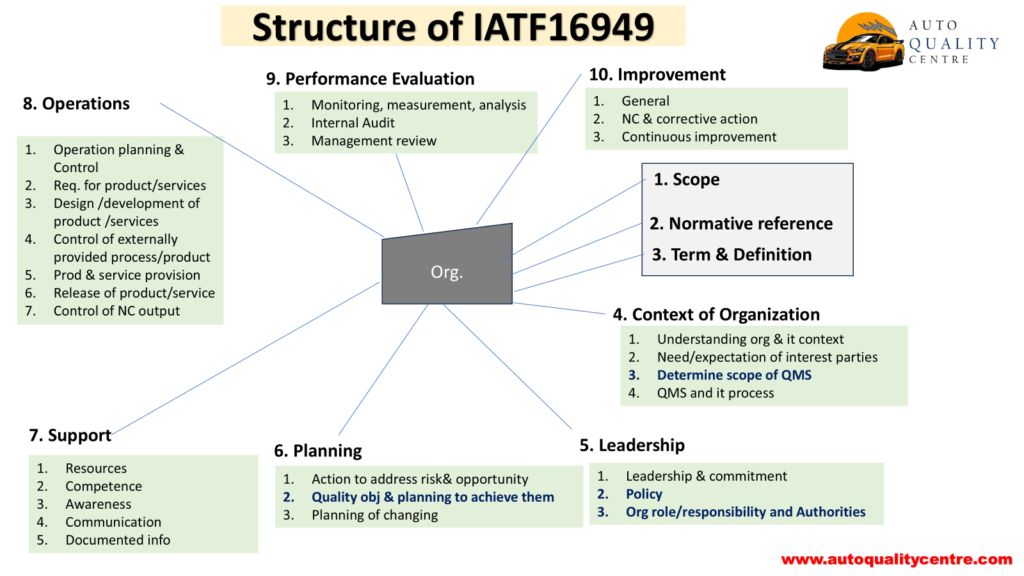
The picture below explains the structure of all the clauses in IATF16949.
This section covers terms and definitions in the automotive industry.
| APQP | FTA (Fault tree analysis) |
| Authorization | Manufacturing / and mfg feasibility |
| Master part | NTF (No trouble found) |
| Control plan | Periodic overhaul / predicative maintenance |
| Customer requirement/ CSR | Reaction plan |
| DFA/ DMA / DFMA | Service part |
| Error proofing | Special characteristic / Critical characteristic |
| Escalation process | TPM |
What is QMS?
QMS (Quality Management System) is a structured framework of processes, procedures, and responsibilities designed to ensure consistent quality, regulatory compliance, and customer satisfaction while improving efficiency and reducing waste.
Core components of QMS
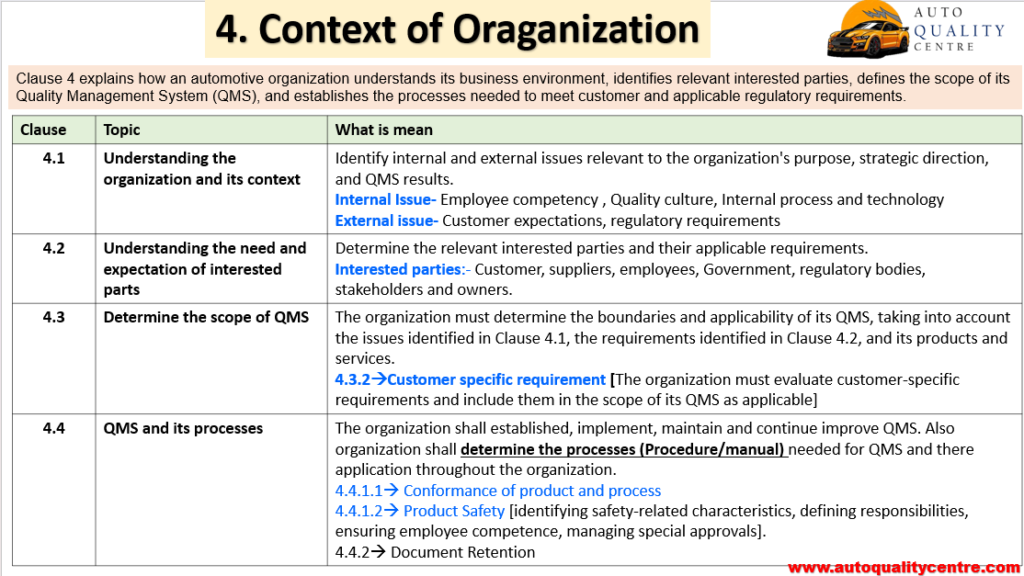
Clause 4 of IATF16949- Context of Organization
Clause 4 explains how an automotive organization understands its business environment and identifies relevant interested parties.
It defines the scope of its Quality Management System (QMS) and establishes processes needed to meet customer, regulatory requirements, and IATF expectations.
There are four sub-clauses. They relate to the context of an organization.
- 4.1- Understanding the organization and its context
- 4.2- Understanding the need and expectation of interested parts
- 4.3- Determine the scope of QMS
- 4.4- QMS and its processes
The clause requires the organization to identify internal and external issues. This evaluation helps align risk and opportunity planning with management system goals. It sets the foundation for determining how the QMS will operate. Clear understanding of context supports sustained compliance and continuous improvement.
It must understand the needs and expectations of interested parties. Then it should determine the scope of the QMS and its processes. This alignment ensures coverage and consistency across all operations. Documented planning helps stakeholders communicate expectations and confirm required outcomes.
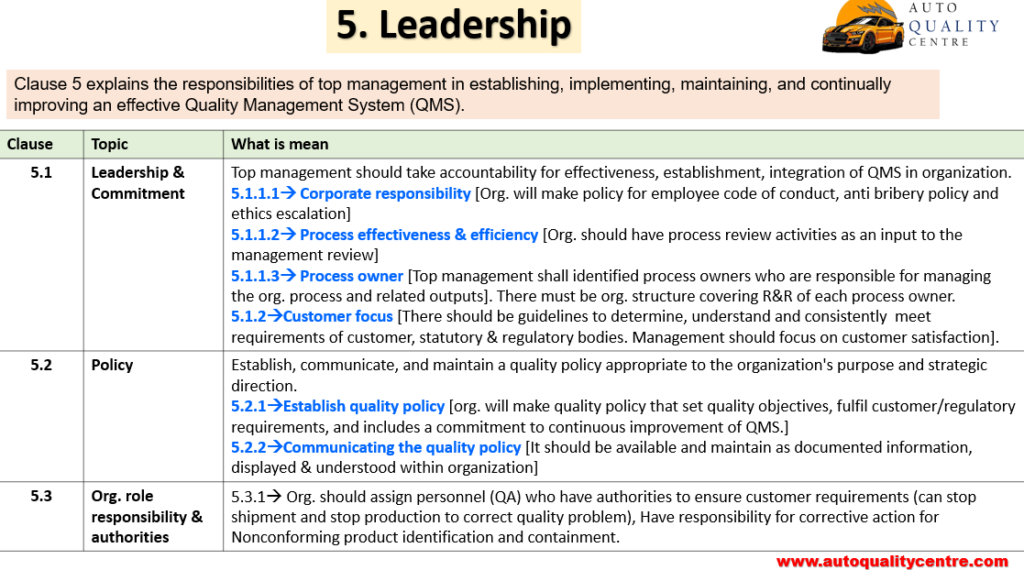
Clause 5 of IATF16949: Leadership
Clause 5 explains the responsibilities of top management in establishing, implementing, maintaining, and continually improving an effective Quality Management System (QMS).
Its sub-clauses are:
- 5.1- Leadership & Commitment: – Organization should fix corporate responsibility (COC), will have management review activities, fix process owner R&R.
- 5.2- Policy: – Organization will establish Quality policy & will communicate within organization.
- 5.3- Organization role/Responsibilities & Authorities: – Organization will have QA person who have authorities to stop/go ahead of non-conforming and conforming products.
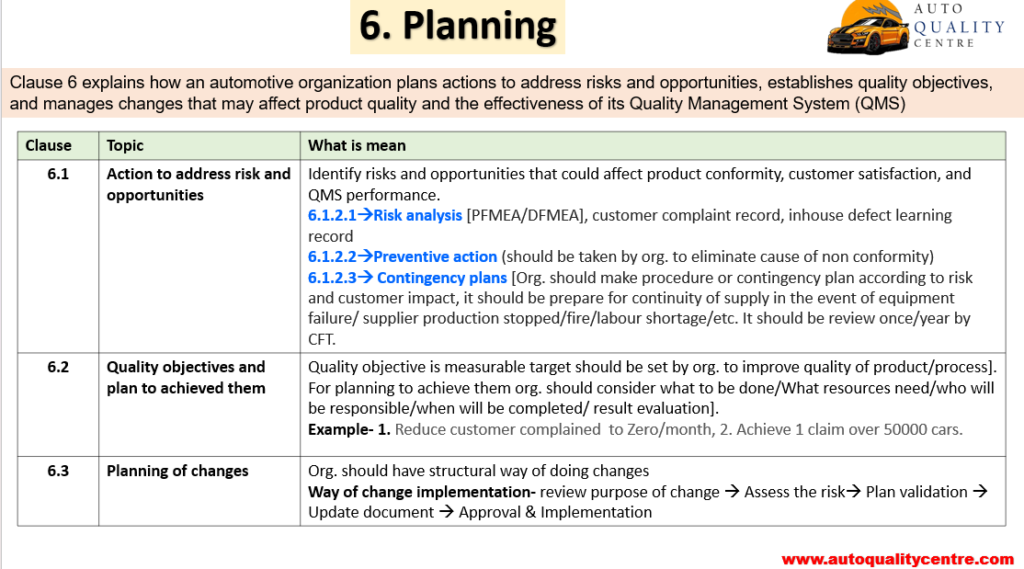
Clause 6 of IATF16949- Planning
This clause explains how an automotive organization plans actions to address risks and opportunities, establishes quality objectives, and manages changes that may affect product quality and the effectiveness of its Quality Management System (QMS)
Clause 6 sub-clause are:
- 6.1- Action to address risk and opportunities– Organization should have procedure to identify risk and opportunities, so they can be address and can be prevent. Should have risk analysis, preventive actions, contingency plans to avoid customer impact.
- 6.2-Quality Objective and plan to achieve them:- Organization should fix measurable quality objective.
- 6.3- Planning of change: – There should be structural way of doing changes.
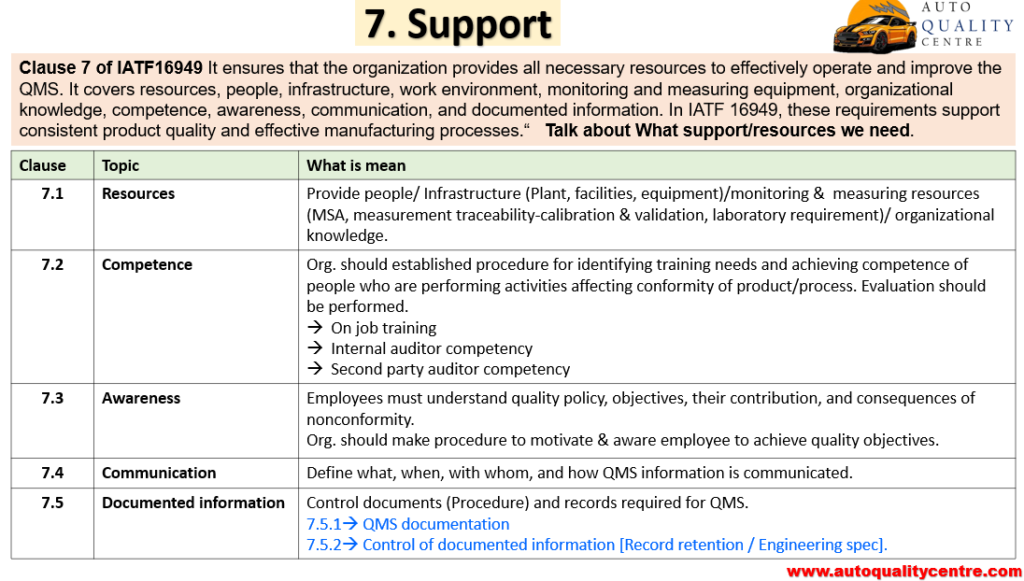
Clause 7 of IATF16949- Support
Clause 7 of IATF16949 requires the organization to provide all necessary resources to operate and improve the QMS. Additionally, these include resources, people, infrastructure, and the work environment. This alignment ensures resource planning supports system effectiveness. Proper allocation enables timely improvements and operational stability.
It also covers monitoring and measuring equipment, organizational knowledge, competence, awareness, communication, and documented information. In IATF 16949, these requirements support consistent product quality and effective manufacturing processes. We should discuss the support and resources we need. It helps ensure the QMS remains capable, compliant, and continually improved.
Sub-clauses of support include:
- 7.1- Resources: – Organization has to provide people, facilities, measuring instruments and test labs as resources to support QMS.
- 7.2-Competence: – Organization has to established procedure to identify competency of people who are responsible for conforming product quality.
- 7.3-Awareness: – Awareness should be provided about quality policy, objectives, consequences of Non-conforming product/process.
- 7.4-Communication: – Define what, when, with whom, and how QMS information is communicated.
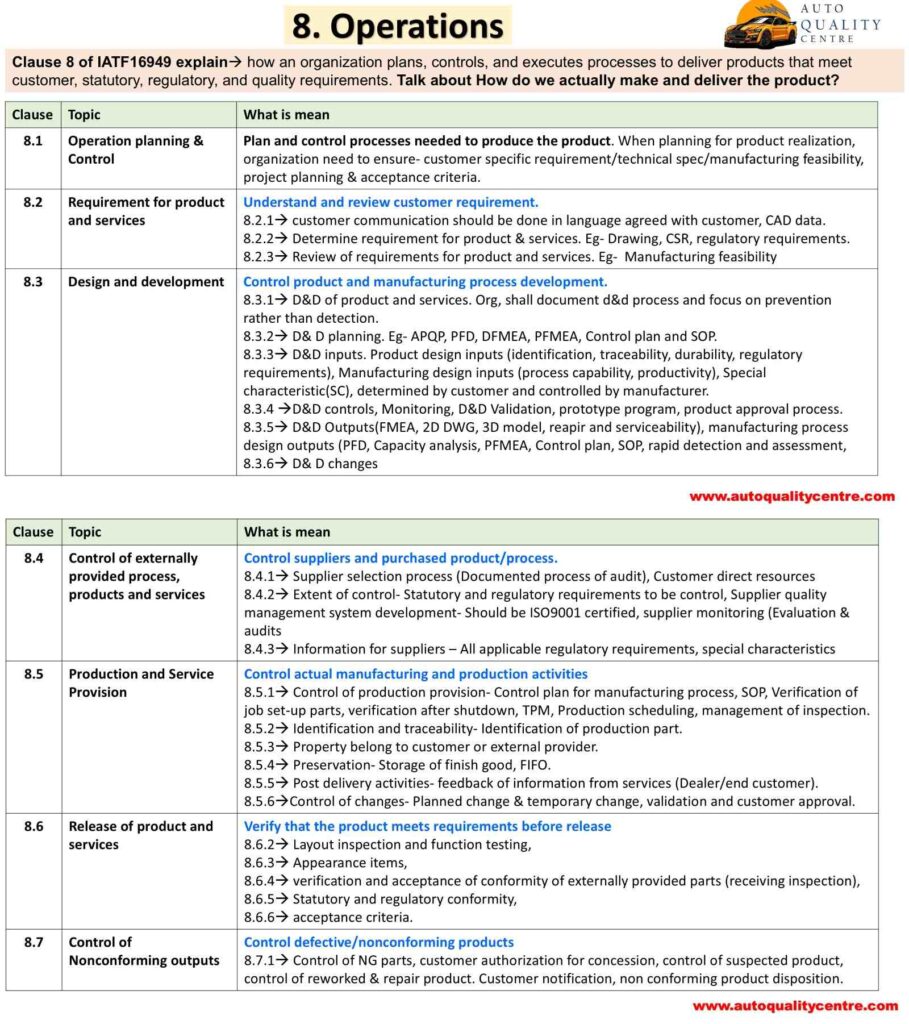
Clause 8 of IATF16949 – Operations
Clause 8 of IATF16949 explains how an organization plans, controls, and executes processes to deliver compliant products. They ensure products meet customer, statutory, regulatory, and quality requirements.
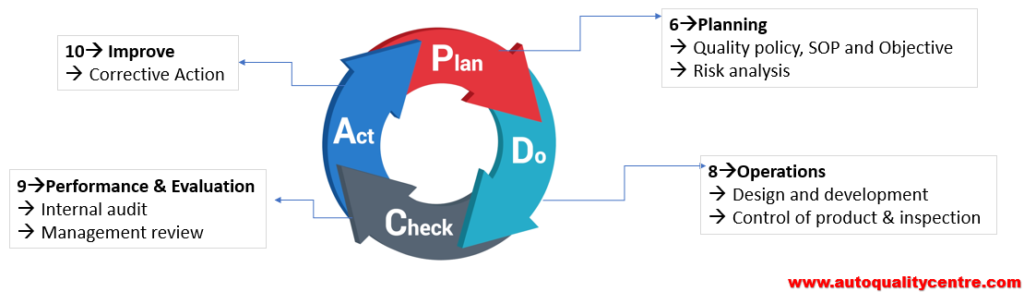
This clause is important and the largest part of this IATF16949. It discusses manufacturing process control in the organization. Operations sub-clauses follow the PDCA approach: Plan (8.1–8.3), Do (8.4–8.5), Check (8.6), Act (8.7).
- 8.1- Operation planning & Control: – Organization should have procedure of plan & control activities to produce the product. Here APQP is an example of plan. CSR, Feasibility and facility planning is considered before product production.
- 8.2-Requirement for product and services: – organization should understand and review customer requirements. Example-Drawing and engineering spec., Regulatory and government requirements.
- 8.3-Design and development– Here requirement are defined for control of Design and development of product and manufacturing process. Organization has to do Design & development planning, has to fix D&D inputs, has to control design and development, and output of design and development.
- 8.4-Control of externally provided process, products and services– requirements related to Control suppliers product & process. Organization should have procedure of supplier selection, supplier monitoring -performance & evaluation.
- 8.5-Product & services provision: – Requirements related to control of actual manufacturing & production activities. Requirements example-control of production provision-SOP/set up verification, etc., identification & traceability of production parts, FIFO, control of changes.
- 8.6-Release of product and services– Verify that the product meets requirements before release.
- 8.7-Control of Nonconforming outputs– Control of defective products.
Clause 9 of IATF16949- Performance Evaluation
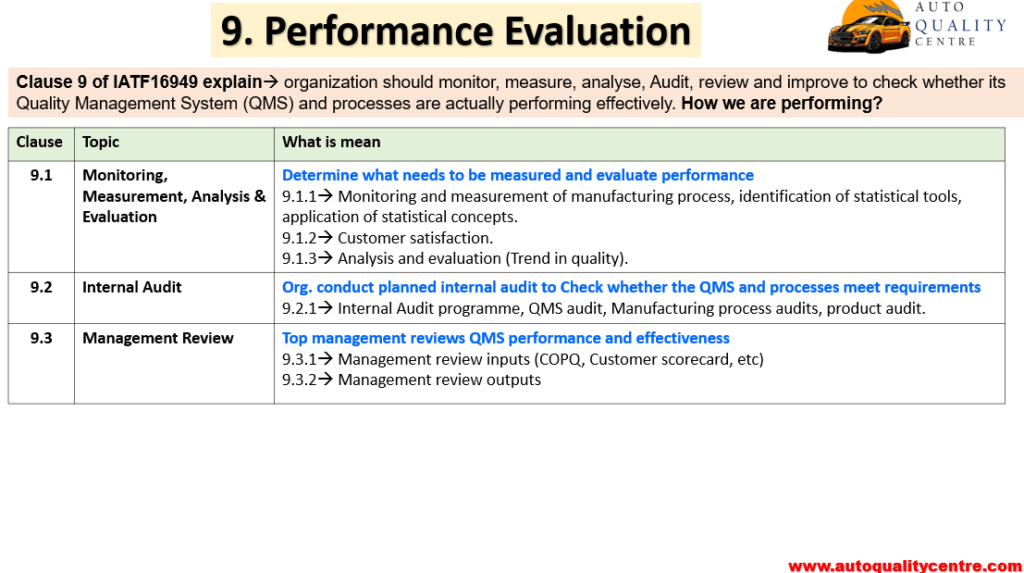
Clause 9 of IATF16949 explains that the organization should monitor, measure, analyze, audit, review, and improve. It must verify that its QMS and processes perform effectively. How are we performing?
Sub clauses of performance Evaluation are.
- 9.1-Monitoring, Measurement, Analysis & Evaluation– Determine what need to be measure and evaluate performance. Example- Customer satisfaction, measurement of manufacturing process.
- 9.2-Internal Audit– Organization should plan internal audits to check whether QMS and process meet requirements.
- 9.3-Managment Review- Management should have review mechanism of QMS performance and its effectiveness.
Clause 10 of IATF16949- Improvement
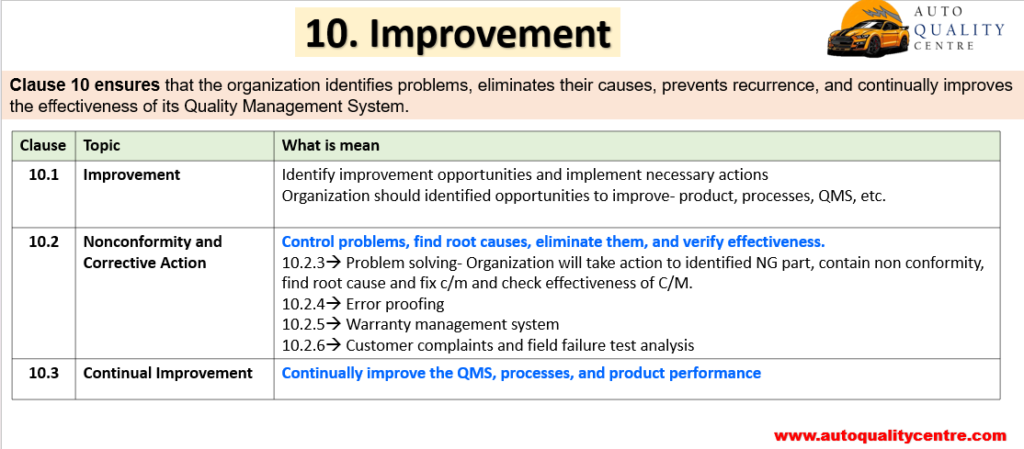
Clause 10 requires the organization to identify problems, eliminate their causes, and prevent recurrence. Additionally, it continually improves the effectiveness of its Quality Management System.
Sub-clauses of improvements exist.
- 10.1-Improvement– Identify improvement opportunities and implement necessary actions. Organization should identified opportunities to improve- product, processes, QMS, etc.
- 10.2- Nonconformity and Corrective Action– Control problems, find root causes, eliminate them, and verify effectiveness.
- 10.3- Continual Improvement-Continually improve the QMS, processes, and product performance
Conclusion — In this article, I have summarized the key points of IATF16949. The text explains the structure, main clauses, and sub-clauses of the standard. These elements clarify how the Automotive QMS operates and what teams must document. It lays a foundation for consistent quality management.
I will also publish articles on each clause for easy understanding of this standard. This approach helps readers grasp requirements and their practical applications. If you like this post, please support me by following me on the social media platforms below.
You may also like: